
HUMAN RIGHTS
Under the “Guiding Principles on Business and Human Rights,” unanimously endorsed and adopted by the UN Human Rights Council in June 2011, companies are expected to address and prevent human rights risks and violations across their entire value chain.
As human rights due diligence obligations, related legislation, and disclosure requirements advance globally — for example under the CSDDD — stakeholder interest, including from institutional investors, is trending upward over the medium to long term. This is driven in part by the launch of PRI Advance and the establishment and growth of TISFD (the Taskforce on Inequality and Social-related Financial Disclosures). In the Japanese domestic context, as human capital management becomes mainstream, international frameworks such as TISFD appear to be integrating fields including human rights, inequality, wellbeing, and human capital — suggesting the social domain will draw increasing attention in Japan as well.

Diagram text (translated) — “Rising investor awareness of ESG’s ‘S’ component and potential future pressure”
Columns: Initiative | Description | Related human rights indicators | Impact on companies
Advance — Launched Dec. 2022, a PRI-led collaborative human rights initiative. Through stewardship, Advance aims to advance the international human rights agenda and improve the alignment of human rights risks/opportunities with financial returns. Signatories currently represent AUM of US$35 trillion.
Advance indicators (excerpt): commitment to human rights; action on human rights impacts; guarantee of a living wage; etc.
TISFD — The Taskforce on Inequality and Social-related Financial Disclosures, launched in 2024. Focused on “people,” it is expected to establish guidance and recommendations for companies and investors (in the manner of TCFD/TNFD).
TISFD indicators (planned): inequality; human rights and wellbeing; wages; impact on communities.
Impact on companies: incorporation of human rights factors into institutional investors’ decisions; discounting of valuations/investment decisions on human rights grounds; references to human rights activity in investor dialogue; inclusion in human rights “laggard” divestment lists; etc.
Codo’s Strengths
Codo Advisory supports corporate human rights initiatives around three pillars — “Human Rights Policy Development Support,” “Human Rights Due Diligence Implementation Support,” and “Remedy Mechanism Development Support.” From drafting a human rights policy to full-scale human rights due diligence implementation, we offer services tailored to client needs, including disclosure support, risk analysis, CSDDD response, and human rights education.
Proactive disclosure is becoming essential in the human rights field as well. For operating companies, respecting human rights across the supply chain and value chain has become a priority issue; for financial and investment institutions, human rights and human capital considerations are increasingly weighted within ESG due diligence for investment decisions. Some companies address this within integrated reports or ESG reports, while a growing number now produce and disclose standalone human rights due diligence reports or human rights impact assessments.
In its human rights work, Codo places importance not only on a risk-based approach but also on demonstrating the link to corporate value. We therefore propose engagements that assume disclosure outputs — starting with a standalone human rights DD report — as a premise from the outset.
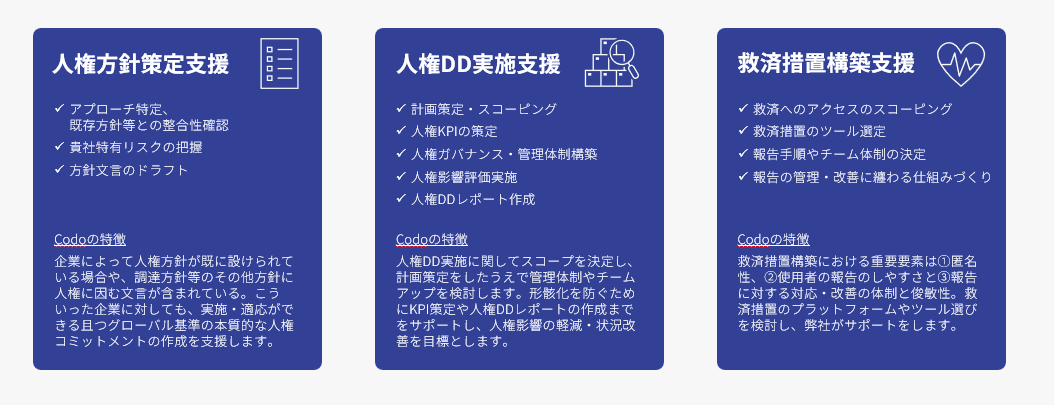
Diagram text (translated) — three service cards
1) Human Rights Policy Development Support — Identifying an approach and confirming consistency with existing policies; understanding company-specific risks; drafting policy language. Codo’s strengths: Even where a company already has a human rights policy, or where human-rights language sits within another policy (e.g. a procurement policy), we help such companies build a practical, adaptable human rights commitment grounded in global standards.
2) Human Rights DD Implementation Support — Planning and scoping; developing human rights KPIs; building human rights governance/management structures; conducting human rights impact assessments; preparing human rights DD reports. Codo’s strengths: We help determine the scope of DD implementation, build a plan, and design the management structure and team. To prevent the process becoming a formality, we support everything through KPI development and report preparation, aiming to reduce human rights impacts and improve conditions.
3) Remedy Mechanism Development Support — Scoping access to remedy; selecting remedy tools; determining reporting procedures and team structure; building a system to manage and improve reporting. Codo’s strengths: Key elements are (1) anonymity, (2) ease of reporting for users, and (3) responsiveness/agility in addressing reports; we support the review of remedy platforms and tool selection.
Initiatives Toward TISFD
As an alliance member of TISFD, we aim to work alongside Japanese companies to establish early examples of TISFD readiness.
Finally, TISFD (the Taskforce on Inequality and Social-related Financial Disclosures) — often described as a “social version of TCFD/TNFD” — is currently under development, with its framework expected to be released in the latter half of 2027. It is expected to bring together perspectives long treated as separate fields in Japan — human capital, wellbeing, diversity, and human rights — into a single framework that forms the basis for disclosure standards. Codo anticipates that as momentum builds around human rights disclosure, discussion will increasingly turn toward its integration with other social issues.
Codo Advisory has been a TISFD alliance member since 2025. Building on this, we aim to work with companies to establish globally leading examples, grounded in TISFD’s approach — please contact us regarding this as well.

Lead / Contact
Representative Director & CEO
Ulysses Aoki
More Services

SUPPLY CHAIN
Sustainable Supply Chain Services
Learn more

SECOND PARTY OPINION
Investor trust depends on SPO.
Learn more

CLIMATE CHANGE
Climate Change / GX Advisory
