
SUPPLY CHAIN
Responsible sourcing (sustainable procurement) refers to a company’s practice of managing the procurement and production of products and services in an ethical and sustainable manner. As supply chains become more global and complex, companies are increasingly required to build more resilient supply chains by combining traditional procurement criteria (QCD — quality, cost, delivery) with ESG-related issues and requirements.
While the means and end goals of building a sustainable supply chain vary greatly depending on supply chain structure, industry, and company size, the six steps outlined in the OECD’s “Due Diligence Guidance for Responsible Business Conduct” form the foundational approach in this field.
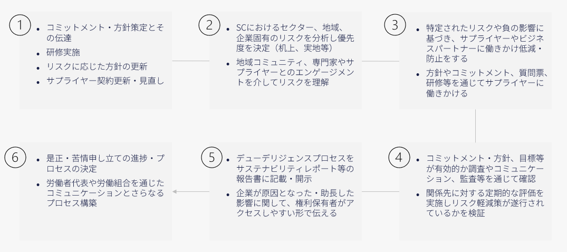
Diagram text (translated) — OECD six-step due diligence process
1) Commitment/policy development and communication; conducting training; updating policy in response to risk; renewing/reviewing supplier contracts.
2) Analyzing sector-, region-, and company-specific risks in the supply chain and prioritizing them (desk research, on-site assessment, etc.); understanding risk through engagement with local communities, experts, and suppliers.
3) Based on identified risks and negative impacts, engaging suppliers/business partners to mitigate and prevent them; engaging suppliers through policies, commitments, questionnaires, and training.
4) Verifying whether commitments, policies, and targets are effective, through investigation, communication, and audits; conducting periodic assessments of partners to confirm risk-mitigation measures are being carried out.
5) Recording and disclosing the due diligence process in reports such as sustainability reports; communicating, in a way accessible to rights holders, impacts the company has caused or contributed to.
6) Determining the process and progress for remediation/grievances; communicating through worker representatives or labor unions, and building further processes.
What Sets Codo’s Services Apart
Codo works on the premise of gradually covering the elements set out in the OECD Due Diligence Guidance, ultimately aiming for (1) completing and continuously improving a PDCA cycle, and (2) identifying and creating opportunities unique to each company. The latter is especially important: a sustainable supply chain can deliver not only risk mitigation but also real competitive advantages and financial returns — such as maximizing efficiency in raw-material procurement and logistics, expanding into global customer bases, sourcing and developing alternative materials, and creating new negotiation opportunities with suppliers.
For this reason, Codo recommends establishing dialogue with suppliers and keeping communication as open as possible, conducting site visits and dialogues, and continuously disclosing results. At the same time, it is essential that a company first has its own foundation in place before setting ESG requirements and expectations for suppliers. We therefore propose support across three phases: first understanding and organizing the company’s own strategy, then establishing a structure for commitments and policy development, and finally implementing initiatives with suppliers.
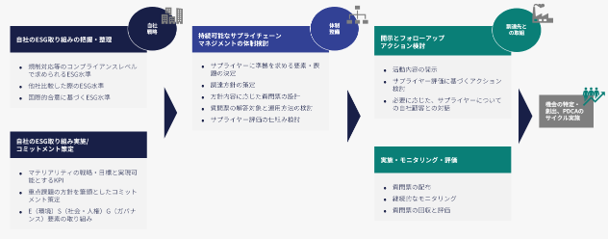
Diagram text (translated) — three-phase supply chain support flow
Phase 1 — Understanding & organizing own ESG initiatives: ESG standards required at the compliance level (regulatory response, etc.); ESG standards relative to other companies; ESG standards based on international consensus. / Implementing own ESG initiatives & developing commitments: KPIs that make materiality strategy and targets achievable; developing commitments led by policy on priority issues; initiatives across E (Environment), S (Social/Human Rights), and G (Governance). [Label: Own strategy]
Phase 2 — Reviewing the structure for sustainable supply chain management: determining the elements/requirements expected of suppliers for compliance; formulating procurement policy; designing questionnaires aligned with the policy; considering respondents and operating methods for the questionnaires; reviewing the supplier assessment mechanism. [Label: Structure development]
Phase 3 — Disclosure & follow-up action review: disclosing activities; reviewing actions based on supplier assessments; dialogue with the company’s own customers about suppliers as needed. / Implementation, monitoring & evaluation: distributing questionnaires; ongoing monitoring; collecting and evaluating questionnaire responses. [Label: Engagement with suppliers]
Final box: Identifying and creating opportunities, and implementing the PDCA cycle.
Across all areas of sustainability and ESG, the supply chain is where the greatest potential risks and opportunities lie. If you are interested in support that translates sustainability activities into practice while also strengthening your supply chain, please feel free to contact us.

Lead / Contact
Representative Director & CEO
Ulysses Aoki
More Services

HUMAN RIGHTS
Business and Human Rights / TISFD-Related Services
Learn more

SECOND PARTY OPINION
Investor trust depends on SPO.
Learn more

CLIMATE CHANGE
Climate Change / GX Advisory
