

Morgane Benoist | Consultant
Share this article
For years, ultra-fast fashion operated in a regulatory blind spot, churning out thousands of cheap new styles a week, without regard to quality or where they would end up. France pushed back in 2024 through a law proposal to stop this trend. Two years on, it is now law, and reshaping how companies operate through a much bigger, EU-wide response. In this Codo Insights, we look at France’s new ultra-fast-fashion law, how the EU is moving towards more sustainable fashion, and how Japan is responding to the same pressures.
France’s Anti-Ultra-Fast-Fashion Law: The Details
France’s 2024 law proposal is now in force, with a graduated eco-penalty targeting non-EU platforms first.
In our original article on this topic back in 2024, we detailed the three major measures of what was at the time a law proposal:
- A new requirement to “display messages” (to be defined later) informing consumers of the economic, social, health and environmental impact of fast fashion next to the retail price of the item on every page that allows purchase.
- A fee of 5 euro from 2025, rising to 10 euro or 50% of the item retail price by 2030. The money gathered through this scheme would be used to finance recycling facilities outside the EU and favor companies complying with EU regulations
- An advertisement ban for fast-fashion retailers, including influencer promotion.
All these measures have been adopted, with some adjustments along the way.
Of the three, the fee (eco-penalty) was the first to take effect, on 1 September 2026. Every garment now carries a score based on how many units a company puts on the market versus how much it invests in encouraging repair.
Compared to the flat 2024 proposal (€5 rising to €10 or 50% of sale price by 2030), the penalty is now item-specific and phases in more gradually, though the 50% ceiling remains. A shirt that falls below the eco-score threshold carries a €6 penalty in 2026, rising to €8.25 by 2030. A coat starts at €12 and reaches €19.50 by 2030. All proceeds go to Refashion, France’s government-mandated eco-organization for textiles.
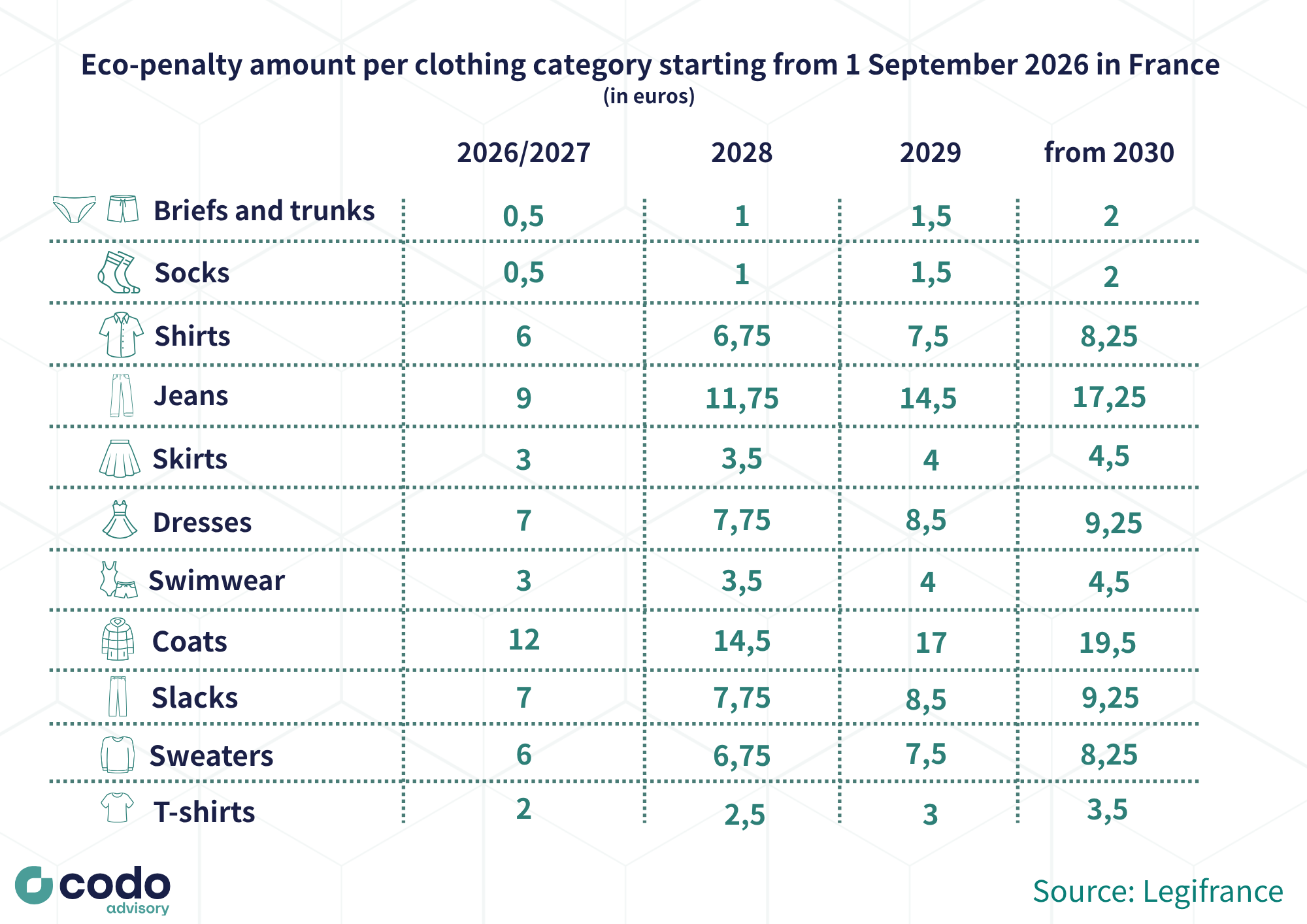
Figure 1: Eco-penalty amount per clothing category starting from 1 September 2026 in France (in euros)
Source: Legifrance (French only)
This fee does not apply to French and EU physical retailers such as Kiabi, Decathlon, Zara or H&M. French Minister Serge Papin defended the distinction in an interview, arguing that there is a difference between “companies that can be held accountable” and “operators whose entire business model is built on dodging regulations and who only respond to sanctions.” He added that European brands have physical stores, create jobs and pay taxes tied to running physical commerce, which makes them a fundamentally different case. This does not mean the law will never target those EU retailers, but the objective is clear: Shein, Temu, AliExpress and others are the first that need to comply.
The remaining measures are set to enter into force at the start of next year. Online retailers will be required to:
- Display messages promoting moderation, reuse, repair, and recycling of products
- Disclose the social impact of each product
- Raise awareness of its environmental and public-health impact
- Inform consumers about the environmental footprint of the delivery option chosen
- Display the manufacturing location of products sold online
These disclosures will need to be clear, legible, and shown in a font size at least equal to the price display and placed right next to it, so consumers can’t miss them while checking out.
Separately, the law imposes a complete ban on advertising for ultra-fast-fashion brands, whether direct or indirect, covering event sponsorships, film product placement, and influencer promotion. This is arguably the hardest measure to enforce in practice. Online advertising and influencer promotion on video platforms sit in a legal grey zone: if a foreign film features an ultra-fast-fashion brand, how would the ban apply? Would a foreign influencer’s Shein haul be blocked from view in France by some filtering mechanism? This is one to watch as enforcement mechanisms take shape.
French Consumers Buy More Clothes than Ever
French fashion brands are collapsing as ultra-fast fashion floods the market.
It’s worth noting that, amid the adoption of new rules, consumer habits have not shifted much yet. Shein overtook the U.S. to make Europe its biggest market in 2024, and its revenue there kept climbing to $14.8 billion in 2025, now 35.4% of its total net revenue. In France specifically, ultra-fast-fashion sales rose 12% in 2025. The French bought 3.6 billion new clothing items that year, beating the previous 2024 record of 3.5 billion — the equivalent of 43 new garments, 4 pairs of shoes, and 12 home linens per person.
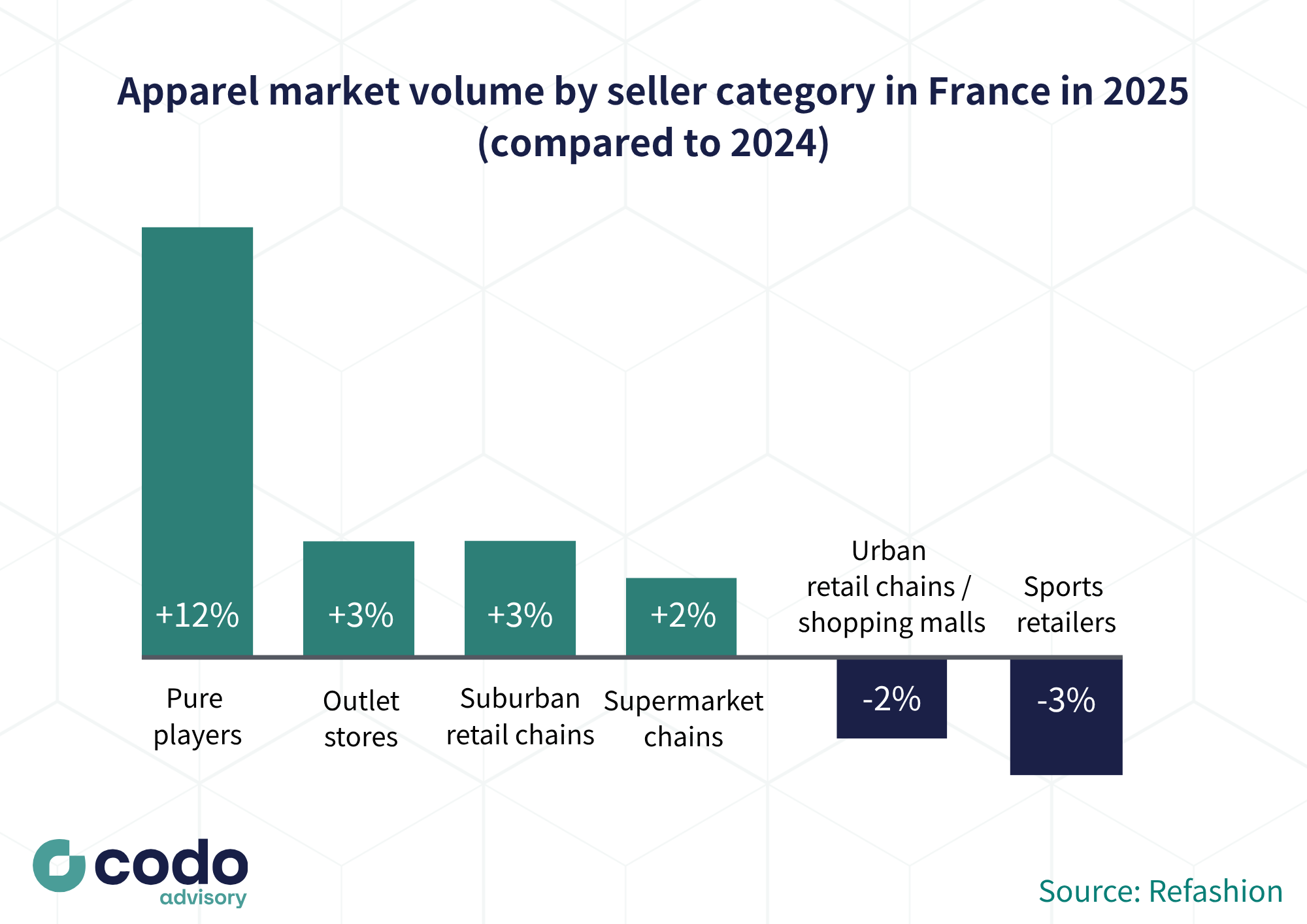
Figure 2: Apparel market volume by seller category in France in 2025 (compared to 2024)
Source: Refashion (French only)
Will consumers change how they shop, rather than simply paying a few extra euros per order? In a market flooded with new cheap clothing every day, it becomes harder for local brands to compete. French brands in particular have suffered greatly from the rise of online-only retailers. Camaïeu, Jennyfer, Naf Naf, Kaporal, IKKS, and others have gone into receivership or disappeared altogether, taking physical storefronts and jobs down with them.
The EU Squeezes Fast Fashion From Both Ends
Brussels is now attacking cheap imports and unsold-stock waste simultaneously, with more rules due by 2027–2028.
Alongside the eco-penalty, France had a second lever aimed at cutting ultra-fast-fashion imports: the Taxe sur les petits colis (small parcel tax). Starting 1 March 2026, France charged €2 per product category on every parcel under €150 arriving from outside the EU. The €150 line marked the point above which ordinary customs duties would apply anyway. On paper, the tax was straightforward, but in practice it quickly became close to useless. Fast-fashion platforms simply rerouted their supply chains around it: cargo planes landed in Belgium or the Netherlands instead of France, with parcels then trucked across the border, free to move once inside the single market.
However, this tax was never really about the money — it was designed to push Brussels towards a Union-wide measure. On 1 July 2026, the Taxe sur les petits colis was suspended as the EU’s own measure took over: a flat €3 customs duty per item category on parcels valued at €150 or under, with a Union Handling Fee due to stack on top of it around 1 November 2026. Together, both charges are meant to hold the line until the EU’s Customs Data Hub comes online in 2028. Here is how the European Commission explains both fees: “While the customs duty eliminates a competitive advantage that the e-commerce operators currently enjoy, the handling fee is meant to compensate for the increasing costs that customs authorities incur for supervising the very significant flow of parcels.”
On 27 August 2026, France’s Economy Minister Roland Lescure reported that small-parcel numbers had dropped 30–40% since the July measure began. While reducing the number of parcels in itself helps reduce customs burdens and the environmental impact of the shipping process, it is only a matter of time until fast-fashion operators find a new workaround, such as shipping in bulk to the EU and redistributing smaller parcels locally.
This is why the parcel tax isn’t the only lever the EU is pulling: since 19 July 2026, large companies across the EU have been banned from destroying unsold clothes, accessories, and footwear, under the Ecodesign for Sustainable Products Regulation (ESPR). This again targets a practice long associated with fast fashion, where usable stock is incinerated or landfilled rather than resold, donated, or recycled. Medium-sized companies have until 2030 to comply, and the ban allows exceptions for safety recalls and damaged goods, but for large retailers this is now a genuine compliance matter. The full ESPR Delegated Act for textiles is set to be adopted in Q4 2027, going even further with ecodesign requirements, along with a Digital Product Passport tracking a garment’s materials and origins.
In other words, the small-parcel taxes and destruction ban are just the opening move. Brussels wants to squeeze both ends of the fast-fashion model — the cheap imports coming in and the unsold waste going out.
The ESPR rules will apply to all products placed on the EU market, regardless of where they are produced. For every fashion company — Japanese ones included — operating in Europe, this could mean rethinking the business model from the ground up.
Japan’s Action Plan: No Binding Regulations
Japan’s own sustainability roadmap sets waste-reduction targets but relies on consumer awareness rather than producer obligations.
In parallel, Japan is pushing its own sustainable-fashion agenda, though a step behind the EU. On 24 March 2026, Japan’s Ministry of the Environment (MOE) published its Action Plan for the Promotion of Sustainable Fashion, setting a target to cut the volume of clothing discarded from households by 25% by FY2030 compared to FY2020 — a reduction of roughly 130,000 tonnes.
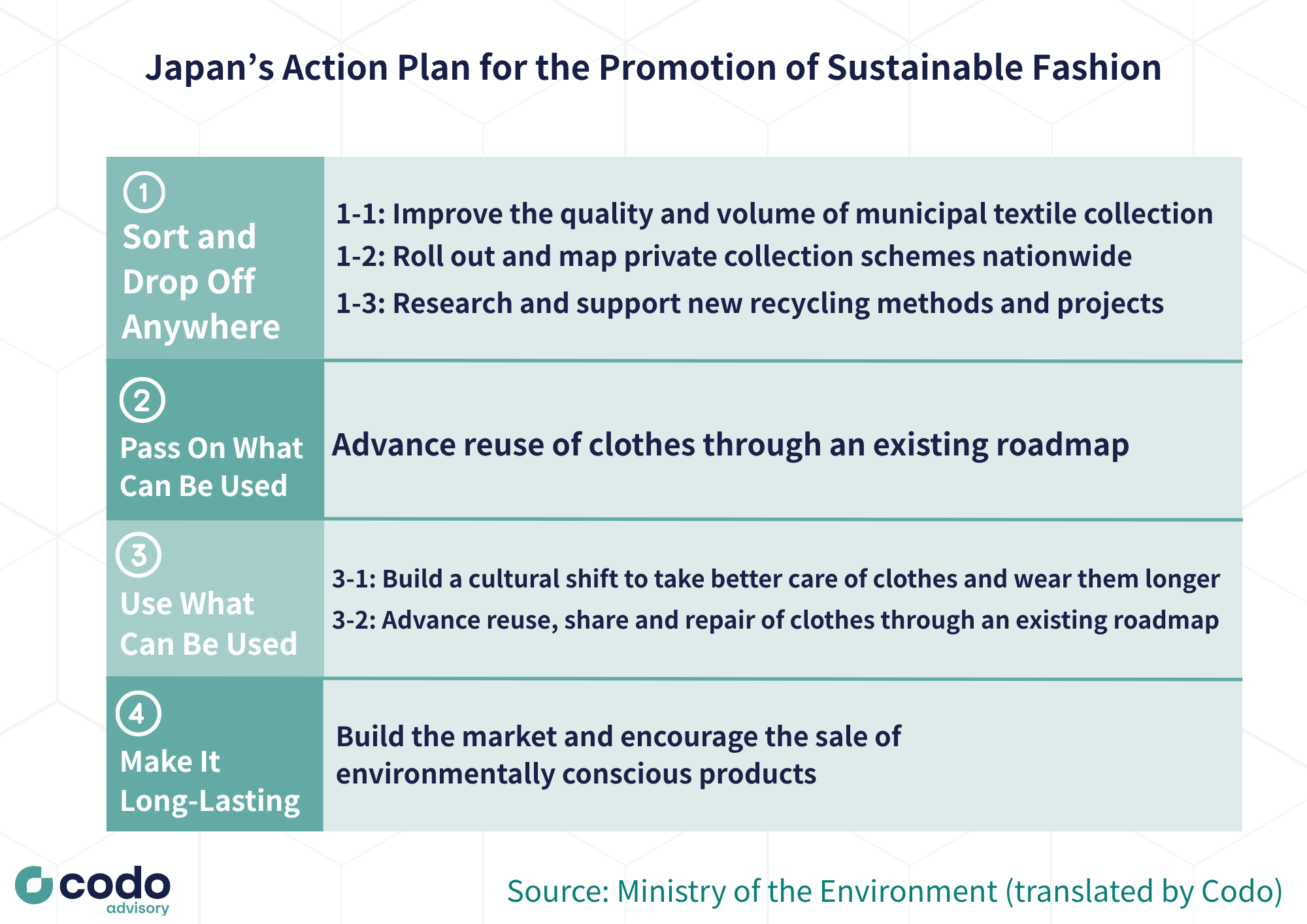
Figure 3: Japan’s Action Plan for the Promotion of Sustainable Fashion
Source: Ministry of the Environment (Japanese only, English translation by Codo)
The plan rests on four pillars:
- “Sort and drop off anywhere nationwide” : improving the quality and volume of municipal textile collection, rolling out private collection schemes nationwide, mapping collection points to make them easier to find, and supporting projects and research into new recycling methods.
- “Pass on what can still be used” : advancing reuse through Japan’s existing roadmap for promoting reuse, sharing, and repair.
- “Use what can be used for a long time” : building a broader cultural shift toward taking better care of clothes and wearing them longer, alongside behavioral-change campaigns aimed at consumers.
- “Make it long-lasting so resources can circulate more easily” : the one pillar aimed at manufacturers, encouraging the sale of environmentally conscious products and creating market conditions that generate demand for them.
While the actions listed are not without value, three of the four pillars address what happens after a garment is bought, while only the fourth touches how clothes are designed and produced in the first place. The plan does name ultra-fast fashion as an obstacle to getting people to “use what can be used for a long time,” but the response is limited to awareness campaigns, events, and education, rather than the kind of binding requirements the EU is rolling out.
As Japan’s biggest fashion players, such as Uniqlo, are forced to redesign products and supply chains to meet EU requirements, there’s a reasonable chance those same durable products become the standard version sold at home in Japan too, helping drive more sustainable practices domestically. On the other hand, in the absence of binding requirements or penalties, ultra-fast-fashion retailers like Shein have no reason to improve their clothing for the Japanese market, which could only accelerate the race to the bottom.
Lessons from France’s and the EU’s New Regulations, and What Companies Can Do
Given the EU and France’s ever-tightening regulations, here are some concrete steps companies can take to prepare:
- Review product design: ESPR’s requirements will force a redesign of materials and manufacturing processes. It’s worth noting that this measure is not limited to clothing — the EU is now prioritizing sectors with high environmental impact such as furniture, iron and steel. Regardless of the product, companies selling in the EU should keep a close eye on regulatory developments.
- Get ahead on traceability: The Digital Product Passport will require data on materials, origin, and supply chain. Building that data infrastructure now avoids a costly scramble later, and is useful well beyond EU compliance. This advice applies to every part of the supply chain, from end sellers to materials manufacturers: being ready may be the key to being chosen.
- Where relevant, diversify away from a small-parcel export model: Companies relying on direct-to-consumer shipping into the EU are exposed to the customs duty and the incoming handling fee regardless of scale. Localizing distribution through EU-based warehousing, or partnerships with EU logistics providers sidesteps that exposure, though it comes with its own cost trade-offs.
Conclusion
Taken together, these measures mark a shift from fast fashion as an unregulated business model to fast fashion as a regulatory target. France’s eco-penalty and parcel tax, the EU’s customs duties and destruction ban, and the ecodesign requirements still to come by 2027 all point in the same direction: squeezing the ultra-fast-fashion model from every angle — imports, waste, and advertising alike. Whether any of this changes consumer behavior remains an open question. What’s less ambiguous is the message to companies: this isn’t a passing wave of protectionism, but the opening phase of a broader European push that will keep tightening, sector by sector, well beyond fashion. For companies, the smart move isn’t to wait and see how enforcement shakes out, but to treat compliance readiness as a competitive question.
- République Française, “The « anti-fast-fashion » law imposes a new sales framework” (20 July 2026)
- European Commission, Implementing the Ecodesign for Sustainable Products Regulation
- Ministry of the Environment, “Action Plan for the Promotion of Sustainable Fashion ~Towards a 25% reduction of waste in 2030~ ” (March 2026) (Japanese only)
- Codo Advisory, “Fast Fashion in the Crosshairs: Will France’s Proposed Law Shake the Industry?” (22 April 2024)
We support companies in building transition plans and verifying their credibility.
