
ABOUT CODO
Together with our clients, Codo takes on the challenge of building a sustainable future in which no one is left behind.
Codo Advisory was founded in 2022 to support Japanese companies’ global expansion and decarbonization. Since then, we have provided support — spanning not only climate change but also areas such as human rights and supply chains, sustainability strategy and disclosure, sustainable finance, and education — to companies across a wide range of industries, as well as governments, municipalities, and non-profit organizations.
As sustainability matures and gains wider recognition as a field, we work with our clients with an emphasis on enhancing corporate value over the medium to long term, generating financial returns, and amplifying the resilience and collective wisdom of society as a whole.
As part of the MCP Group, Codo brings a financial and investment industry perspective and an understanding of global investor expectations. With offices in Tokyo and Fukuoka, Codo supports not only large corporations but also local and regional businesses and municipalities, contributing to the advancement of sustainability across the country.
The World of Sustainability, As We See It

Diagram text (translated) — three-phase timeline
~1980s–2014: Responses to major incidents and issues such as wars, conflicts, and pollution
2015–2024: Structuring the correction of negative impacts
2025 onward: Improving resilience, creating impact, and “expressing” value
At Codo, we believe the world of sustainability and ESG is now in its third phase.
It began with pollution, war, and conflict, leading to the founding of the United Nations and the proposal of the Universal Declaration of Human Rights. In the 1980s, discrimination issues such as segregation policies triggered the spread of SRI (Socially Responsible Investment), which later evolved into CSR (Corporate Social Responsibility).
From 2011 onward, efforts began to visualize and structure non-financial performance in order to correct the negative impacts generated by companies and nations. By identifying issues, converting them into data, and bringing them into media coverage, the direction shifted from soft “promotion” toward harder forms of enforcement. In particular:
- Establishment of the Guiding Principles on Business and Human Rights (2011)
- Publication of the IIRC’s Integrated Reporting Framework (2013)
- Adoption of the SDGs (2015)
- Establishment of the TCFD (2015)
- GPIF’s adoption of ESG-based investment (2017)
These developments introduced new frameworks of thinking that go beyond short-term financial metrics and involve society as a whole. Over the more than ten years since the sustainability/ESG ecosystem took shape, we can point to real progress: a shift from CSR to CSV management and integrated thinking, a growing appeal to institutional investors around non-financial thinking, and the hardening of disclosure into law.
At the same time, while the field of sustainability has matured compared to the past, substantive improvement and reform still appear incomplete. Mapping progress toward the SDGs through 2025 shows that, of the 169 indicators, about 18% are progressing well toward the 2030 targets — but another 18% are regressing rather than progressing, and 17% show stalled progress.
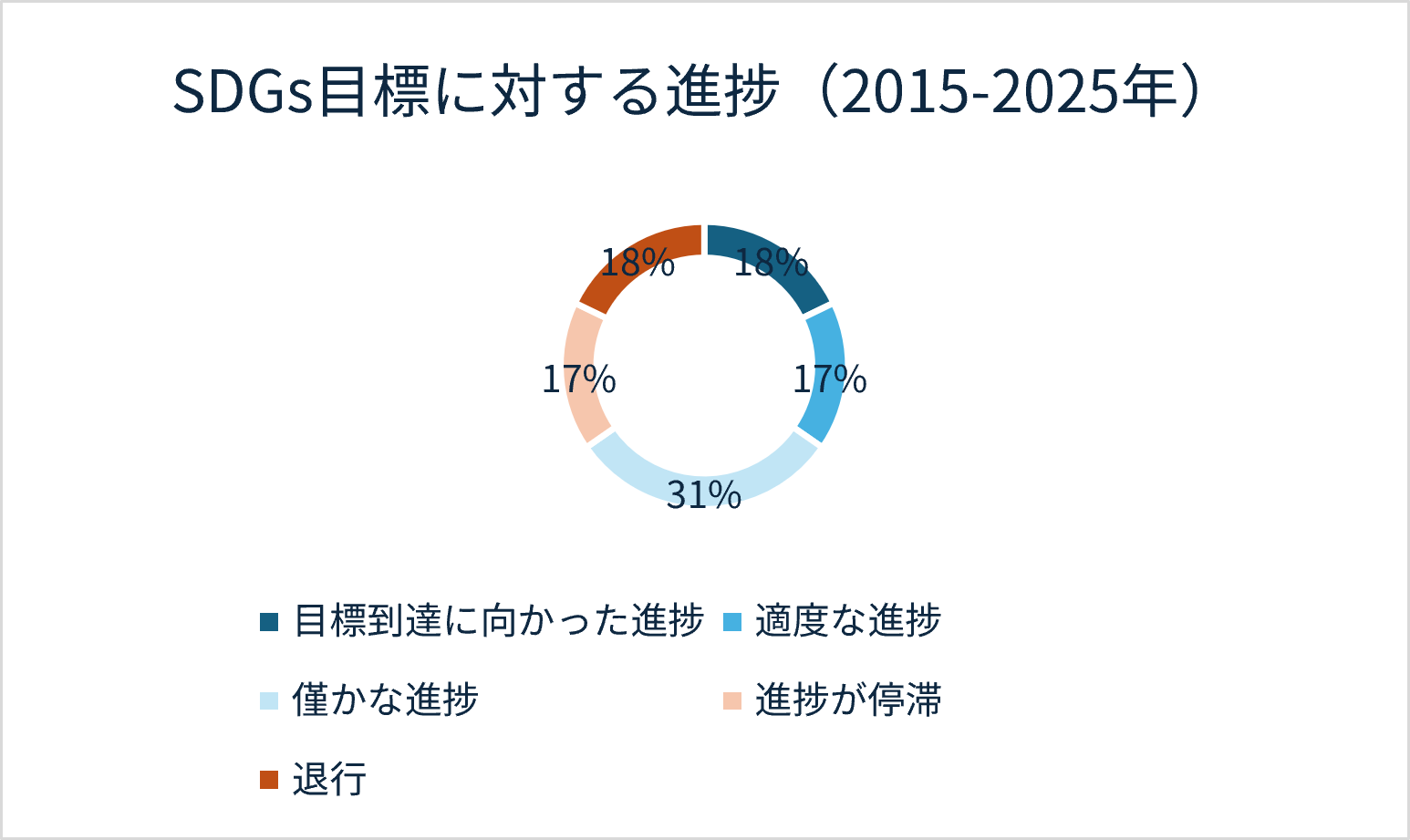
Created based on the United Nations “The Sustainable Development Goals Report 2025”
n conclusion, while the relatively qualitative field of sustainability has become more structured, looking only at outcomes reveals a dilemma: it cannot necessarily be said that society is moving in a better direction. Beyond correcting negative impacts, reform that generates significant social value (impact) is needed.
From the 2010s — a globally peaceful era in which social issues were actively debated and improvement measures proposed — we have since experienced the COVID-19 pandemic and a further paradigm shift in political and social thought. In today’s society, marked by heightened vulnerability and uncertainty, two major questions are being asked: (1) the sustainability of organizations, and (2) their reason for being and value. At Codo, we are convinced that “essential sustainability management” is the key to answering both of these questions.
Services We Offer
Sustainability / Strategy Advisory
- Core Sevices
We offer a wide range of services for creating opportunity and value, including “Co-Impact Bridge,” which provides end-to-end support from strategy through communication and disclosure to enhance corporate value; advisory support for financial institutions; and impact-related services.
- Sector-Specific Services
We have experience across many areas of sustainability, including climate change response such as transition strategy development, human rights and TISFD response support, sustainable supply chain development support, various ESG scoring and disclosure support, and third-party assessment support for green finance.。
- Sustainability Operations Support
We offer hands-on services in which Codo supports client companies’ sustainability teams by serving as an internal project member.
Corporate Education & Training
- Codo’s Education & Training Services
We offer training programs that facilitate internal alignment on disclosure — including an overview of ISSB/SSBJ — as well as basic sustainability/ESG training for managers and for new and mid-career hires. We can also develop and propose programs tailored to your needs.
- Workshop-Style Training of International Standard
We offer experiential workshops such as “Climate Fresk” and “Biodiversity Collage,” which build foundational knowledge of climate change and biodiversity, and “Digital Collage,” which explores the connection between the digital world and its negative environmental impact.
