

Morgane Benoist | Consultant
Share this article
Three years after the ISSB set out to create a universal language for sustainability disclosure, the world is speaking it, albeit unevenly. Some are moving forward, others are retreating, and one major economy is walking away from the table altogether. A mid-2026 assessment of where ESG reporting stands, and an update to our April 2025 Insights “ In Turbulent Times, Slow and Steady Wins the Race: ISSB, SSBJ, CSRD, and US ESG Regulations”
ISSB: The New Baseline
ISSB is now the global reference point for sustainability disclosure, focusing next on refining details for nature-related disclosure.
The ISSB’s bet, set out when it released IFRS S1 and S2 in 2023, was never to be the most ambitious framework: only the most adoptable. It is built on single materiality: companies only disclose how sustainability matters affect enterprise value, not how the enterprise affects the world. That design deliberately lowers the barrier to adoption, and the bet has paid off: by the IFRS’s count, 36 jurisdictions have adopted the ISSB standards or are formally moving to do so with major economies including China and India progressing toward implementation.
The work since has been about usability. In December 2025 the ISSB issued targeted amendments to IFRS S2: it allowed financial institutions to limit Scope 3 Category 15 to financed emissions, granted jurisdictional relief on global-warming-potential values and measurement methods, and permitted industry-classification systems other than GICS. The amendments apply to reporting periods beginning on or after 1 January 2027, with early application allowed.
Attention has now turned to nature. At its April 2026 board meeting in Beijing, the ISSB decided to advance nature-related disclosure through a non-binding IFRS Practice Statement rather than a standalone standard, reflecting a deliberate effort not to disrupt jurisdictions still implementing S1 and S2. The Practice Statement will draw on the TNFD framework, including its LEAP (Locate, Evaluate, Assess, Prepare) approach, and an exposure draft is expected in October 2026. The ISSB stresses that material nature-related information is already required under IFRS S1; the Practice Statement only clarifies how to provide it.
SSBJ: The New Japanese Standard
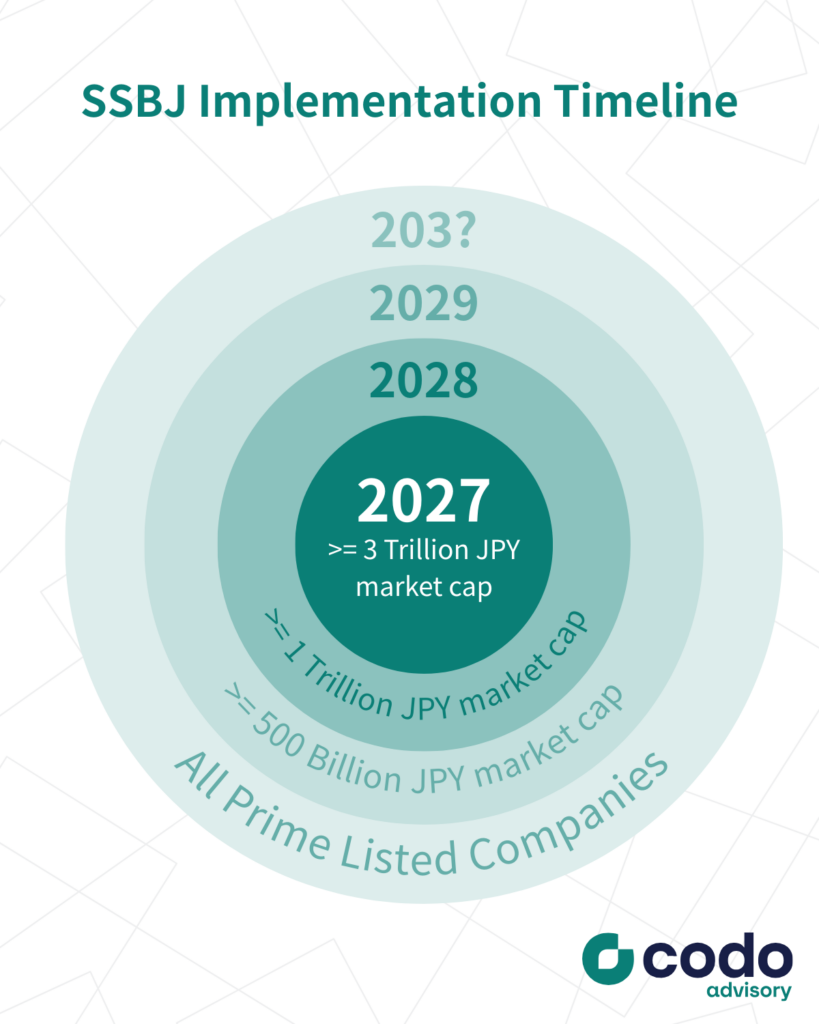
Tier-1 (>= ¥3 trillion market cap) issuers are already in year one of SSBJ reporting, with first reports due March next year.
Japan has followed the script it has signalled since the ISSB succeeded the TCFD. The SSBJ standards, finalised in March 2025, are functionally equivalent to IFRS S1 and S2, localised to Japanese law, and, like the ISSB, built on single materiality.
On 20 February 2026, the Financial Services Agency finalised the Cabinet Office Order making SSBJ disclosure mandatory for Tokyo Stock Exchange Prime-market companies above a market-capitalisation threshold. Application is phased by average market cap: companies above ¥3 trillion report from the fiscal year ending March 2027, those above ¥1 trillion from March 2028, and those above ¥500 billion from March 2029, with smaller issuers still under review. A two-stage transitional disclosure applies for the first two years. The same Cabinet Office Order also expanded human capital disclosure, a requirement separate from the SSBJ standards: from FY 2026, securities-report filers must additionally disclose their human-capital strategy linked to corporate strategy, their policy for setting employee pay, and the year-on-year change in average annual salary.
SSBJ continues to track the ISSB closely, including the December 2025 IFRS S2 amendments, keeping Japanese reporting interoperable with the global baseline and reducing the cost of dual reporting for companies operating across jurisdictions.
Disclosure is not the only new obligation. The amended GX Promotion Act, passed on 28 May 2025 and effective 1 April 2026, turns Japan’s emissions trading scheme (GX-ETS) from voluntary into mandatory for businesses whose Scope 1 emissions average 100,000 tonnes or more over the prior three years : roughly 300~400 companies that together account for about 60% of national emissions.The scopes differ (GX-ETS captures direct emissions, while securities-report disclosure under SSBJ is group-wide and includes Scope 2 and 3) but the verified-emissions data largely overlaps and can be built once and used for both.
The EU Omnibus: What is Left?
The Omnibus has scaled back the scope of its mandatory reporting but double materiality remains, which is a key difference from other schemes such as SSBJ. The question for Japanese companies is whether SSBJ-aligned reporting will be accepted under N-ESRS and spare a parallel EU filing.
Originally three different schemes, CSRD (Corporate Sustainability Reporting Directive), CSDDD (Corporate Social Due Diligence Directive) CBAM (Carbon Border Adjustment Mechanism), the EU Omnibus has been created as a response to companies who voiced their fears at their overwhelming burden. The Omnibus I directive entered into force on March 18th 2026; member states must transpose the CSRD provisions by March 19th 2027 and the CSDDD provisions by July 26th 2028.
The CSRD now applies only to companies with more than 1,000 employees and more than €450 million in net turnover: a dual threshold replacing the old “two-out-of-three” and cutting the population in scope from roughly 50,000 companies to about 5,000. On the standards side, the European Commission published a draft of the revised ESRS on May 6th 2026 and closed consultation on June 3rd. By the Commission’s own account, mandatory datapoints fall by more than 60% and total datapoints by more than 70%, voluntary disclosures are removed entirely. On the positive side, compliance costs per company are expected to drop by more than 30%. The revised ESRS apply from FY2027, with optional early adoption for FY2026, and a voluntary standard for smaller companies (the VSME) is expected in July 2026.
For non-EU groups, the trigger is now €450 million of net turnover generated in the EU (at group level) plus an EU subsidiary or branch with more than €200 million in turnover — up from the previous €150 million EU-turnover threshold. EFRAG (European Financial Reporting Advisory Group) estimates this leaves roughly 1,200 non-EU companies in scope, an 88% reduction, including 100~150 companies from Switzerland and Japan. The separate standard that will govern how those non-EU parents report (the N-ESRS) has been deliberately deferred to align with the revised ESRS. EFRAG expects to deliver its technical advice around the end of January 2027.
EFRAG has proposed three approaches:
1) full global reporting aligned with ISSB/SSBJ
2) a mixed model combining global climate disclosure with EU-specific disclosures for EU impacts
3) full ESRS application
The Japanese government has formally endorsed the first two, for the obvious reason that they would allow SSBJ-aligned reporting to satisfy N-ESRS simultaneously — eliminating a parallel reporting burden.
The due diligence directive (CSDDD) was scaled back further: obligations now apply only above 5,000 employees and €1.5 billion in turnover, application is unified to 26 July 2029, the requirement to implement climate transition plans has been removed (the requirement to report them remains), and the harmonised EU civil-liability regime has been dropped in favour of capped penalties. Through all of this, double materiality survived: the single feature that still separates the European framework from every other major regime.
The United States: A Hostile Environment
While the US is scaling back domestically, large groups are still subject to the reporting rules of the Omnibus and the growing presence of ISSB.
On 29 May 2026 the SEC proposed to rescind its 2024 climate disclosure rules in their entirety. A final vote is expected later in 2026 or in early 2027. In the Commission’s view, securities disclosure should be confined to information material to investors’ financial decisions; the climate rule exceeded the agency’s statutory authority and its costs were not justified by investor benefit, with the agency estimating savings of roughly $4.9 billion a year.
A federal exit is not the end of US disclosure. Three forces keep US companies reporting. The first is state law: California’s SB 253 requires Scope 1 and 2 reporting for FY2025 data from companies with over $1 billion in revenue doing business in the state, with a first deadline of 10 August 2026 that regulators have reaffirmed. SB 261 (climate-risk reporting for companies above $500 million) is on hold pending appeal and New York is advancing a bill modelled on California’s. The second is the extraterritorial reach of the CSRD and the gravitational pull of the ISSB baseline. The third is plain investor and value-chain demand.
Companies are saying less while doing the same or more: the Financial Times reported that 71% of the 50 largest US companies remain committed to their climate goals while removing public “ESG” references.
However, the picture is not uniform. Without a federal mandate, some US companies may see little incentive to be proactive. Globally exposed, investor-watched companies continue; domestically focused ones may quietly scale back. The United States is vacating the role of a federal standard-setter, but its companies remain tethered to the global baseline by Brussels’ extraterritorial reach and the ISSB’s gravity (even as the EU has itself trimmed that reach through the Omnibus). The “Brussels effect” is real but attenuated, and the de facto point of convergence is increasingly neither Washington nor Brussels but the ISSB.
| Disclosure Framework | SSBJ Standards | ISSB Standards (IFRS S1, S2) | The Climate Rule | SB253: CCDAA, SB261: CFRA | EU Omnibus |
| Region | Japan | International | USA | California, USA | EU |
| Mandate Level | Mandatory | Voluntary | Mandatory | Mandatory | Mandatory |
| Materiality | Single | Single | Single | Single | Double |
| Issuing Entity | SSBJ | ISSB / IFRC / IASB | SEC | California Senate | ESRS |
| Full Name | Sustainability Standards Board Japan Standards | International Sustainability Standards Board | The Enhancement and Standardization of Climate-Related Disclosures | SB 253: Climate Corporate Data Accountability Act, SB 261: Climate-related Financial Risk Act | Omnibus I, Directive 2026/470 |
| Declaration Date | 2025 | 2023 | 2024 | 2023 | 2026 |
| Scheduled Initial Implementation | 2027 | Voluntary (36 jurisdictions have adopted or are planning to adopt ISSB-based standards) | 2025 | 2026 | 2024 data reported in 2025 for first wave, with increasing inclusions every year through 2028 |
| Current Implementation Timeline | 2027 | Voluntary | N/A | SB 253: 2026 SB 261: N/A | FY 2027 (optional early adoption in FY 2026) |
| Changes since declaration | 2026 March: Amendments to align with ISSB IFRS S2 amendments | 2025 December: Amendments to GHG disclosure requirements in IFRS S2 | Rescinding proposal on May 2026: The Climate Rule may disappear | SB253: No changes as of yet SB 261: on hold pending appeal | “Omnibus” package revisions simplifying disclosure requirements, reducing scope |
Table 1: Summary Table of Major Regional Reporting Frameworks
Conclusion
The architecture of ESG disclosure has largely been built. The standards exist, the frameworks are converging, and the data infrastructure is maturing. The convergence point that has actually won is the ISSB: not because it was the most ambitious option, but because it was the most adoptable, and Japan’s SSBJ rides that baseline while avoiding the political turbulence that has buffeted more ambitious regimes.
The EU held a single line (double materiality) that still distinguishes it from every other major framework; that the line survived heavy industry pressure is a victory in itself. The United States has stepped back at the federal level, but its companies remain pulled toward the global baseline by extraterritorial rules and investor demand. Whether that quiet continuation hardens into durable practice or fades without a domestic mandate is the open American question.
The architecture is in place. The question now common to all regimes is the same one that has always mattered most: whether disclosure converts into decision, and ultimately into action.
Sources and Additional Information
- Use of IFRS Sustainability Disclosure Standards by Jurisdiction – IFRS
- Sustainability Standards Board of Japan
- Corporate Sustainability Reporting – European Commission
- SEC Proposes Rescission of Climate-Related Disclosure Rules – US Securities and Exchange Commission
We help companies at all stages of their sustainability journey
