



Yuna Okawa | Sustainability Consultant
Share this article
As the transition to a decarbonized society gains momentum, it is essential not to overlook the less visible impacts that may arise in its wake. Without a deliberate focus, decarbonization efforts risk deepening social inequalities and enabling human rights violations. For companies, incorporating the principles of just transition and social equity is not only a matter of responsibility but also a strategic opportunity to enhance long-term resilience. In this article, we outline the core concepts behind just transition and social equity, examine real-world cases of human rights challenges and propose practical steps companies can take to navigate the path toward a fair and sustainable future.
Introduction: Why Focus on Just Transition and Social Equity Now?
Awareness of the need for a decarbonized society is growing rapidly. At the same time, we must not overlook the unintended negative consequences that can emerge from decarbonization efforts.
One example is the projected surge in demand for cobalt—an essential material for electric vehicles and renewable energy storage systems. By 2040, global cobalt demand is expected to double. As of 2023, approximately 70% of the world’s cobalt supply comes from the Democratic Republic of the Congo, where poor working conditions, forced labor, and the involvement of an estimated 25,000 children in hazardous mining activities remain widespread. As decarbonization accelerates, it risks driving up demand for resources in ways that intensify human rights violations and create new pressure points in global supply chains.

Source:Global Critical Minerals Outlook 2024(IEA)
A truly sustainable transition to a decarbonized society cannot be achieved by focusing solely on environmental considerations. All three pillars of ESG—environmental, social, and governance—must be balanced to ensure meaningful and lasting impact. Ultimately, it is individuals who bear the consequences of negative outcomes. For companies to thrive in society, coexistence with workers and local communities is not optional—it is essential.
What is a Just Transition?
A Just Transition refers to the shift toward a sustainable economy that addresses climate change while ensuring no one is left behind. It is about aligning decarbonization efforts with social equity, so that the transition benefits all members of society.
While initiatives to move toward a decarbonized society are often described under the umbrella of “Green Transformation” (GX), this environmental shift is inherently accompanied by broader social change. This parallel process—aimed at achieving sustainable social systems—is known as Social Transformation, a framework that seeks to realize universal human development. A Just Transition, therefore, integrates both environmental and social dimensions, ensuring that the move toward sustainability is fair, inclusive, and equitable for all.
The Perspective of Social Equity: Who Is Affected and How?
The transition to a decarbonized society carries the risk of exacerbating existing social imbalances, such as regional disparities, generational gaps, and gender inequalities. In Japan, structural challenges are particularly evident due to the vulnerability of regional economies and the gender divide in the labor market. As previously mentioned, the acceleration of certain initiatives can lead to rapid market expansion, which in turn highlights conflicting structures. As illustrated by the example of cobalt, discussions around Just Transition and Social Equity often center on human rights violations.
Relying solely on governments to address social equity while leaving it unaddressed by companies can result in companies being held accountable when social equity issues arise. Therefore, addressing social equity is not just an ethical matter—it is also a question of corporate responsibility.
The United Nations Guiding Principles on Business and Human Rights (UNGPs) categorize corporate involvement in human rights violations into three areas:
1 . Cause : When Corporate Activities Directly Result in Human Rights Violations
Case: Coal Mine Closures in Cesar, Colombia
In Colombia’s Cesar region, a company holding mining rights to two coal mines ceased operations due to a drop in coal prices. In a region where 80% of economic activity depended on coal mining, the closures had a severe impact—resulting in the loss of 180 billion Colombian pesos (approximately 5 billion yen) in annual economic output and 5,000 jobs. Local stakeholders voiced concerns that the company had withdrawn without reinvesting in the community that had long supplied a finite resource. They stressed that this lack of reinvestment deprived local residents of both livelihoods and clarity about the region’s future direction, highlighting the direct social consequences of the company’s exit.
2. Contribution: When Corporate Activities Contribute to Human Rights Violations
Case: Aizu-Wakamatsu Smart City Initative and the Digital Divide (link in Japanese only)
In Aizu-Wakamatsu, Fukushima Prefecture, the city-led “Smart City Initiative” carries the risk of excluding residents who are unfamiliar with digital technologies, particularly the elderly, creating a digital divide. Without proper education and support systems to ensure that all residents can benefit from new technologies, the initiative could lead to human rights violations by leaving certain groups behind.
3. Linkage: When Business Relationships Based on Mutual Interests Lead to Human Rights Violations
Case:Forced Labor in Xinjiang and the Aluminium Supply Chain
Several major automobile manufacturers, including Japanese companies, have been reported to use aluminum sourced from Xinjiang, China, which may be linked to forced labor practices in the region. Both the manufacturers and their consumers are implicated in human rights violations through their involvement in this supply chain, and the scope of this impact is significant.
If a just transition is not realized, it’s possible to consider the human rights implications through the lens of Cause, Contribution, and Linkage. For instance, if an energy company accelerates its decarbonization strategy and abruptly lays off employees working in fossil fuel-based divisions, this could potentially be seen as a “Cause” of human rights violations. In the cobalt example mentioned earlier, companies that manufacture products using cobalt as a raw material are causing human rights violations within their supply chain (= Linkage).
Furthermore, if a company rejects the need for a social transition, this could be seen as a Contribution. Ignoring the need to address climate change accelerates environmental damage, which ultimately results in human impacts, such as the rise in climate refugees. In this sense, refusing to engage in the transition is contributing to a social structure that promotes human rights violations.
How Companies Can Promote a Just Transition
As key drivers of the transition to a decarbonized society, companies must consider the social dimensions of their transition strategies. With diverse stakeholders and substantial societal influence, businesses play a critical role in shaping the outcomes of this transformation.
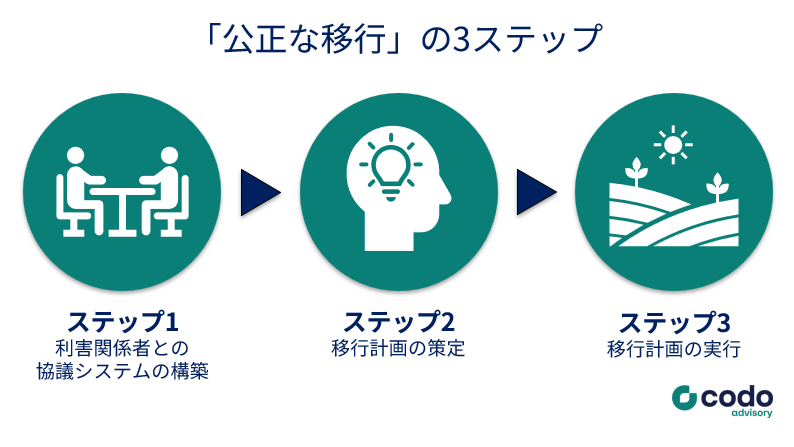
To effectively promote a just transition, companies should consider adopting the following three strategic steps:

Step 1: Establish Consultation Systems with Stakeholders
The foundation of a just transition is built through social dialogue with a wide range of stakeholders, including employers and workers, businesses and local communities. To achieve this, companies must establish systems that facilitate dialogue at every stage of their climate action strategy—from initial discussions, current state assessments, and goal-setting, to planning, implementation, monitoring, and reporting. It is essential that the conditions for consultation and the process for appointment are transparent, with formal and regular engagement mechanisms in place. In some cases, it is recommended to document these consultations and agreements or to formalize them as a just transition policy.
Step 2: Transition Planning
Once the foundation for social dialogue is established in Step 1, companies can begin to develop a transition plan based on these discussions. Corporate decisions regarding decarbonization often have negative impacts on workers and local communities, so it is crucial to identify these risks and integrate strategies for resilience into the transition plan. The plan should encompass not only the entire organization but also extend to the supply chain. Integration with existing corporate initiatives such as human rights due diligence and sustainable supply chain frameworks should be considered wherever possible.
Step 3: Implementation of the Transition Plan
In Step 3, the execution of the transition plan will rely on transparency with stakeholders and strong external collaboration. As mentioned in Step 2, the plan must involve not only the company but the entire supply chain. Engaging with external partners in the execution of said plan will amplify the effectiveness of the efforts and lead to more impactful outcomes.
Additionally, incorporating the perspective of a just transition as a standard for responsible investing is becoming increasingly common among investors. Specifically, there is a growing demand for the disclosure of labor practices and workforce planning. Companies that address social equity through a just transition are viewed as sustainable, and investors can accelerate the realization of a sustainable society by investing in them.
Summary: How a Just Transition Enhances Corporate Resilience
The impacts of climate change are primarily felt in vulnerable regions where capital and wealth are not concentrated. In particular, many human rights violations and damages linked to climate change occur at points within supply chains where transparency is low. Many companies may feel that their ability to understand and address these situations on their own is limited. This is precisely why companies with significant leverage need to take the lead in driving a just transition. If they fail to do so, they risk causing or exacerbating human rights violations in unseen parts of the supply chain, which could pose serious business risks. What cannot be overlooked is that the transition towards decarbonization and the tackling of social issues must be a parallel process if aiming for a truly just transition. To tackle such complex issues, a third-party perspective and specialized expertise is indispensable.
At Codo Advisory, we integrate the perspective of just transition into our transition planning services, leveraging our expertise in crafting transition plans. Specifically, we help companies address multi-layered challenges, including the development of human rights policies, risk analysis, human rights due diligence, and sustainable supply chain management. Furthermore, we advocate for the formulation of just transition corporate policies tailored to each company or industry. We believe that companies committed to the transition to a decarbonized society, while ensuring social coexistence, can enhance their resilience and competitive advantage in the market. Our mission is to support such companies in building a “future resilient to change.”
More about this topic
- Climate Change and the Just Transition: A guide for Investor Action – Grantham Research Institute on Climate Change and Environment
- Social Transformation Framework – World Benchmarking Alliance
- Guiding Principles on Business and Human Rights – United Nations
- ソーシャル・トランスフォーメーション・フレームワーク ~誰一人取り残さないように企業を評価し、インセンティブを与えるために~ – World Benchmarking Alliance (Japanese only)