
ESG Regulations

Codo's Insights, ESG Regulations, Renewable Energy

France’s and EU’s Fast-Fashion Crackdown and What It Means Beyond the EU

For years, ultra-fast fashion operated in a regulatory blind spot, churning out thousands of cheap new styles a week, without regard to quality or where they would end up. France pushed back in 2024 through a law proposal to stop this trend. Two years on, it is now law, and reshaping how companies operate through a much bigger, EU-wide response. In this Codo Insights, we look at France’s new ultra-fast-fashion law, how the EU is moving towards more sustainable fashion, and how Japan is responding to the same pressures.


Codo's Insights, ESG Regulations, ESG Reporting

Uneven Ground: The State of ESG Disclosure in 2026

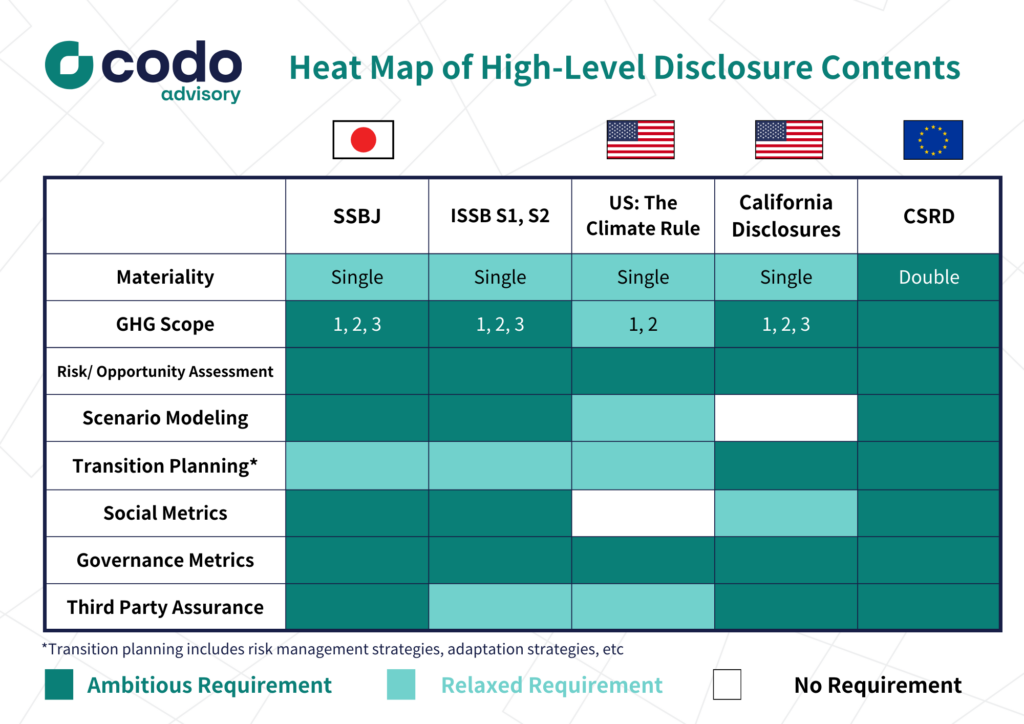
Three years after the ISSB set out to create a universal language for sustainability disclosure, the world is speaking it, albeit unevenly. Some are moving forward, others are retreating, and one major economy is walking away from the table altogether. A mid-2026 assessment of where ESG reporting stands, and an update to our April 2025 Insights “ In Turbulent Times, Slow and Steady Wins the Race: ISSB, SSBJ, CSRD, and US ESG Regulations”

Codo's Insights, ESG Regulations, ESG Reporting

Assessing the Components of a “Good” CSRD Report

As Japanese companies begin preparing CSRD-aligned reports we are frequently asked how companies can ensure their reports can be viewed as credible compared to industry peers. To answer these questions, we have assessed published reports to prepare a case study for 5 CSRD reports from various industries to give concrete examples of what “good” and “poor” reports include.

Codo's Insights, ESG Regulations, ESG Reporting

In Turbulent Times, Slow and Steady Wins the Race: ISSB, SSBJ, CSRD, and US ESG Regulations

As promised, Japan has published their ISSB-aligned ESG reporting standards, the SSBJ standards. As a substitute for TCFD reporting, Prime listed companies will be required to issue SSBJ reports starting from 2028 for the highest market cap tier. Nothing about the standards is shocking or extremely challenging, as one can expect from Japanese regulations. Just four months ago the lack of ambition in this standard’s release would have been a cause for disappointment, but in this era of shifting political and regulatory tides, the steady consistency of Japan’s regulations provide a beacon of hope that in calmer waters, progress towards a sustainable future prevails.

Codo's Insights, ESG Regulations, ESG Reporting

CSRD Compliance in Practice: Insights from Corporate Preparations

The Corporate Sustainability Reporting Directive (CSRD), which mandates sustainability reporting for companies, requires applicable organizations to begin collecting data in 2024, with the first official disclosures expected in early 2025. The CSRD revises the existing Non-Financial Reporting Directive (NFRD 2014) and expands on the concept of double materiality by requiring companies to disclose both how sustainability factors financially affect the company (“financial materiality”) and how the company’s activities impact the environment and society (“impact materiality”). Under the CSRD, companies must report under the European Sustainability Reporting Standards (ESRS)—encompassing 12 items (ESRS 1–2, ESRS E1–5, ESRS S1–4, ESRS G1)—and the scope will extend to companies outside of Europe over time. As companies look ahead to the first disclosure requirements in early 2025, many in Europe are already making significant preparations. This article will explain the current efforts by these companies and highlight the key characteristics of the CSRD.

Codo's Insights, ESG Regulations

Fast Fashion in the Crosshairs: Will France’s Proposed Law Shake the Industry?

Fast fashion has taken over consumers’ closets, leveraging low prices and speed. However, this affordability often conceals serious issues such as environmental impact and workers’ rights violations. In this article, we discuss a proposed fast fashion regulation law in France and explore what this new regulation might mean for the global fashion market, including Japan.

Codo's Insights, ESG Regulations

The EU Green Taxonomy: An ambitious framework to redirect financial flows towards sustainability

As the world grapples with the urgent need for sustainable practices, the European Union has spearheaded the development of the EU Green Taxonomy — an instrumental tool in promoting sustainable finance. Following the Green Deal passed in 2019, the regulation was adopted in June 2020 and entered into force in July 2021, with a roll-out plan in several phases. Codo summarizes the potential consequences it holds for Japanese companies operating in the global markets with input from Tatjana Gerling, an ESG Expert based in Europe. For our readers that are not familiar with the EU Green Taxonomy, we recommend checking out the annex at the bottom of the page where we introduce the fundamentals of the taxonomy.